
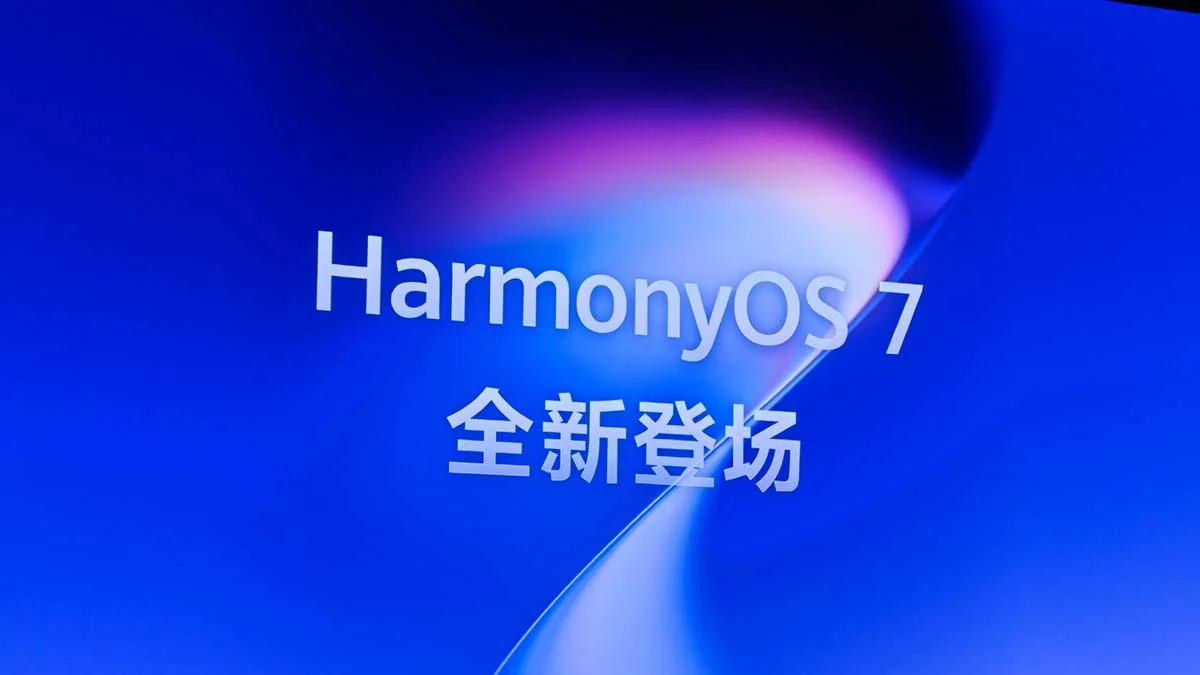
Only four days after Apple confirmed that its Siri AI upgrade would not be launching in China, Huawei appeared in Dongguan and positioned HarmonyOS 7 as the start of what it calls the “agent era.” The space Apple has been unable to occupy is now being actively claimed by Huawei with an architecture designed specifically around it.
What HarmonyOS 7 actually changes
The most important update is the introduction of the HarmonyOS Intelligent Agent Framework 2.0, which reworks the operating system around an “intent-as-service” approach. Instead of users moving through multiple apps step by step, the system is designed to translate a single natural-language request into a complete action flow.
At the core of this shift is Xiaoyi, Huawei’s AI assistant, which has been rebuilt from a standard voice assistant into a system-level AI agent. According to Huawei, Xiaoyi now has control over more than 2,100 system functions and works together with over 2,000 external AI agents created within Huawei’s developer ecosystem.
Richard Yu, head of Huawei’s Consumer Business Group, described the moment as a clear generational shift: “In 2019, HarmonyOS was born. In 2023, native HarmonyOS apps began. In 2026, HarmonyOS enters the Agent era.”
Beneath this layer operates openPangu 2.0, Huawei’s updated foundation model. The Pro version reportedly contains 505 billion parameters, while the Flash version has 92 billion, both supporting context windows of up to 512K tokens. On-device AI models with around 30 billion parameters are expected to arrive on Kirin chips by autumn 2026. Huawei also claims HarmonyOS 7 delivers performance gains of more than 15% compared to version 6.1.
The company states that the system achieves a task completion rate above 90%, although this figure comes from internal benchmarks and has not been independently verified.
The market position is consolidating
The figures presented at HDC 2026 point to a shift that has already been unfolding. In Q1 2026, HarmonyOS reached 19% of China’s smartphone operating system market, ahead of Apple’s iOS at 16%, while Android remained dominant at 65%. According to Counterpoint Research, HarmonyOS first overtook iOS in China during Q2 2025.
This trajectory is significant because it reflects more than feature competition—it highlights a structural split. China is both a market where Apple’s full AI stack is not currently available and one where Huawei has tailored its ecosystem to local services and regulations.
Within this ecosystem, Xiaoyi connects with partners such as Ctrip for travel planning and Ant Medical for healthcare-related data processing. These integrations sit deeply inside China’s digital services layer in a way Apple’s platform does not currently replicate.
Where the limits are
Despite the momentum, the scope of Huawei’s challenge to Apple should be viewed with context. HarmonyOS 7 is still in developer beta, and its stable consumer release is expected later this autumn. The network of more than 2,000 AI agents is primarily built around China’s domestic app ecosystem.
Although Huawei reports over 400,000 apps and services, this is still significantly smaller than Apple’s global App Store ecosystem. Plans to expand HarmonyOS internationally remain largely aspirational at this stage.
There is also an interesting design convergence: HarmonyOS 7 adopts a Liquid Glass-style visual language, similar to Apple’s iOS 26 and Samsung’s One UI 9. While the underlying systems and regulatory environments diverge, the visual direction of modern mobile interfaces is increasingly overlapping.
The longer arc
The existence of HarmonyOS is a direct consequence of US sanctions. After Huawei lost access to Google’s Android ecosystem in 2019, it was forced to build its own operating system from the ground up. By January 2026, more than 90% of Huawei devices were already running this fully in-house version.
What began as a necessity has evolved into a strategic advantage in the Chinese market—especially in areas where Apple’s AI features are absent or restricted.
In this sense, the trajectory is clear: sanctions created the foundation, and regulatory fragmentation shaped the opportunity that Huawei is now expanding into.