
To understand where mobility technology is heading, it is not enough to analyze reports or spreadsheets—you need to stand on the factory floor. Recently, I visited Savannah, Georgia, for a landmark event at the Hyundai Motor Group Metaplant America (HMGMA). The site was marking the beginning of production for the Kia Sportage Hybrid, its first Kia model and also its first hybrid electric vehicle.
To better understand the brand’s direction, I drove a borrowed Kia Telluride through Georgia’s highways. It is a striking three-row SUV that competes directly with luxury offerings, particularly through its advanced driver assistance systems and high-end comfort features. A deeper review of the Telluride will follow in a later piece.
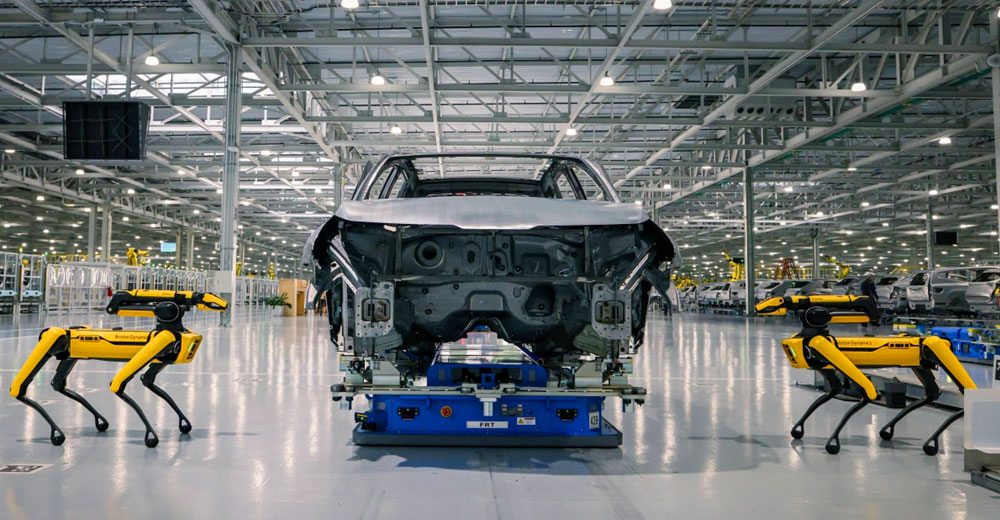
Stepping out of that refined SUV and into the Metaplant felt like crossing into a different industrial era. The facility is not simply a car factory—it resembles a large-scale robotics environment that demonstrates how automation is reshaping manufacturing itself.
Let’s examine where automotive production is heading. Afterwards, we’ll conclude with my Product of the Week: the laptop I used during my trip to Georgia.
How HMGMA Differs From Tesla and BYD
To understand why the Metaplant represents a shift in manufacturing philosophy, it helps to compare it with competitors like Tesla and BYD.
Tesla transformed automotive production with “Gigacasting,” using massive high-pressure casting machines to produce large structural sections of vehicles as single pieces. This approach reduces complexity and accelerates production, especially for high-volume models like the Model Y.
However, this method also creates factories that are difficult to adapt. If market demand shifts—for example, from fully electric vehicles toward hybrids—reconfiguring these production systems becomes slow and expensive.
BYD follows a different strategy based on deep vertical integration. The company produces most components internally, including batteries and semiconductors, leveraging scale and manufacturing control to dominate output. While extremely efficient, this model relies heavily on volume and less on production flexibility.
HMGMA, by contrast, is built around flexible manufacturing architecture. The facility is designed to handle multiple powertrains on the same production line with minimal reconfiguration. During my visit, I observed hybrid systems for the Sportage moving alongside production setups intended for fully electric vehicles like the Hyundai Ioniq 5. This adaptability provides a major advantage in a market where consumer demand is constantly shifting.
For Kia, this means it is not locked into a single technological path. The factory can adjust quickly, reducing exposure to sudden changes in EV adoption trends.
Agentic AI and Build-to-Order Manufacturing
Understanding the Metaplant also requires distinguishing between basic automation and what is increasingly referred to as agentic AI.
Traditional automation represents the execution layer: robotic arms welding vehicle frames, autonomous mobile robots transporting components, and robotic systems handling inspections and logistics. These systems perform precise, predefined tasks efficiently and reliably.
At HMGMA, examples of this include autonomous mobile robots (AMRs) moving vehicles through production stages and Boston Dynamics robot systems used to inspect factory conditions and detect anomalies.
However, the emerging shift lies in agentic AI functioning as a cognitive orchestration layer. Instead of factories relying on production forecasts, future systems could respond directly to real-time customer demand.
In this model, a customer could configure a fully customized vehicle online—down to battery type, interior materials, and onboard computing modules—and submit the order. The AI system would then coordinate procurement, production scheduling, and robotic execution instantly, integrating the vehicle seamlessly into the manufacturing pipeline.
This would enable true large-scale build-to-order manufacturing, long considered the “holy grail” of industrial production.
20-Year Evolution: From Assembly to 3D Printing
The Metaplant represents an early stage in a much longer transformation. If current trends in robotics, additive manufacturing, and AI continue, automotive production could evolve dramatically over the next two decades.
2026 to 2030: The Rise of Humanoids and AMRs
Fixed conveyor systems are gradually replaced by autonomous mobile robots that dynamically route vehicles through production. Humanoid robots also begin entering factories, handling physically demanding or hazardous tasks alongside human workers.
By 2030, human-robot collaboration becomes standard across advanced facilities.
2030 to 2035: The Cognitive Factory
Agentic AI takes over logistics coordination within factories. Production systems become self-adjusting and self-optimizing, with predictive maintenance dramatically reducing downtime. Build-to-order manufacturing begins replacing inventory-heavy dealership models.
2035 to 2040: Large-Scale Additive Manufacturing
Industrial 3D printing becomes central to vehicle production. Structural parts, cabins, and even battery components are produced layer by layer using advanced composites and metals, significantly reducing the need for traditional assembly infrastructure.
2040 and Beyond: The Raw-to-Finished Model
Factories evolve into fully integrated production environments where raw materials enter one end and finished vehicles exit the other. Additive manufacturing systems and AI orchestration work together to construct vehicles from the ground up in a continuous, automated process.
The Human Side of Automation
These changes will reshape not only production systems but also the workforce itself. While automation introduces disruption to traditional manufacturing roles, it also creates new categories of technical employment.
Kia refers to its HMGMA workforce as “Meta Pros,” reflecting a shift in required skills. Future factory employees will focus less on manual tasks and more on managing robotic systems, interpreting AI diagnostics, and overseeing complex production environments.
This transition demands continuous education in robotics, AI systems, and industrial software. Both companies and governments will need to invest heavily in retraining programs to support this shift.
Ultimately, factory work evolves from physical execution to cognitive oversight of automated systems.
Wrapping Up
The launch of the Hyundai Motor Group Metaplant America represents a significant milestone in industrial manufacturing. By emphasizing flexible production systems, advanced robotics, and early-stage integration of AI coordination, Hyundai and Kia are positioning themselves for a manufacturing landscape defined by constant change.
Over the next 20 years, automotive production is likely to move from rigid assembly lines to adaptive, software-driven systems—and eventually toward fully additive manufacturing environments.
Companies that fail to adapt to this shift risk being constrained by outdated production models, while those embracing flexibility, automation, and AI-driven orchestration may define the next era of the automotive industry. The factory of the future is not just a place where cars are built—it is a continuously evolving system of intelligence, automation, and material transformation.