
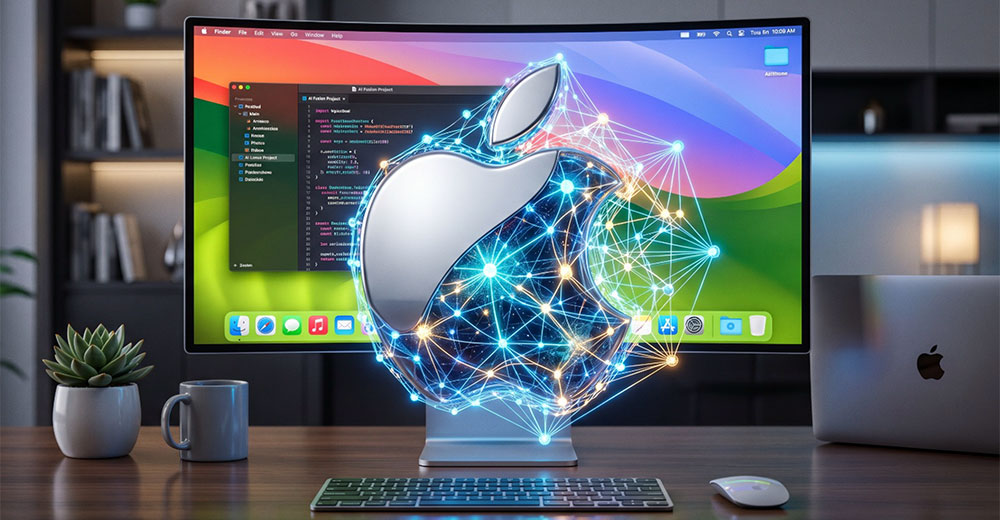
Watching WWDC26, it becomes increasingly clear that Apple has finally acknowledged the intensity of the artificial intelligence arms race. After years of comparatively quiet iteration during the generative AI boom, while Microsoft and Google dominated attention, Apple has now repositioned itself with a far more aggressive and integrated AI strategy.
This year, Apple did not simply join the conversation—it restructured its entire ecosystem to embed AI directly into the user experience layer.
With announcements spanning macOS 27 “Golden Gate” and the long-awaited overhaul of Siri, Apple is attempting to align its platforms more closely against Google’s Android AI direction and Microsoft’s deep Copilot integration. What emerged is a strategy that emphasizes tight ecosystem control, external partnerships, and a strong focus on user experience.
Let’s break down what was revealed at WWDC26 and why it matters across consumers, developers, and the competitive landscape. The analysis concludes with my Product of the Week: the HyperX FlipCast Microphone.
Foundation Built on Gemini
The most significant shift in Apple’s AI strategy is its decision to rely on Google’s Gemini platform as part of the underlying architecture for Siri’s evolution.
Siri has long been criticized for failing to keep pace with modern AI assistants. While competitors evolved into context-aware systems, Apple’s assistant remained relatively limited in capability, becoming emblematic of the company’s slower entry into generative AI.
Earlier attempts to strengthen Siri through enterprise partnerships did not meaningfully change its trajectory. However, Apple’s current approach integrates Gemini as a foundational layer, combined with Apple’s own on-device models under a “you-centered” architecture.
This hybrid model blends local processing with cloud-based intelligence, allowing Apple to maintain its emphasis on privacy while still accessing large-scale computational power when needed. User data remains isolated, reinforcing Apple’s longstanding privacy positioning.
Strategically, this creates a clear contrast with Microsoft’s Copilot approach, which is deeply embedded across productivity workflows. Apple instead focuses on integrating AI into everyday consumer interactions, emphasizing personalization and seamless usability rather than enterprise saturation.
macOS Golden Gate and Ecosystem Evolution
Alongside AI integration, Apple introduced macOS 27 Golden Gate, with a strong emphasis on refining system design and performance.
A new “Liquid Glass” interface control allows users to adjust visual clarity dynamically, reflecting Apple’s continued focus on aesthetic precision. The update also introduces redesigned system elements, improved toolbars, and smoother animation systems designed to enhance spatial consistency across the OS.
Performance improvements are a key focus. Apple claims app launch times have improved by up to 30%, while system responsiveness in applications like Photos has seen dramatic gains in rendering and transfer speeds. Even older devices benefit from a new system scheduler designed to optimize workload distribution, extending support to hardware as far back as the iPhone 11.
Cross-device integration has also been improved, particularly in network switching between Wi-Fi and cellular connections, as well as a more intelligent system-wide search index that better understands user data across devices.
Apple also introduced limited interoperability improvements, enabling easier media sharing with users on Windows and Android ecosystems.
In spatial computing, Vision Pro gains enhanced capabilities for transforming standard images into immersive environments, while Apple Maps receives a major upgrade in environmental realism, including detailed rendering of urban elements such as buildings, lighting, and reflections.
Siri’s AI Transformation
The centerpiece of WWDC26 is the complete reconstruction of Siri AI.
Rather than functioning as a command-based assistant, Siri is now designed as a conversational AI system capable of contextual understanding and fluid interaction. Voice output is more expressive, and system-wide dictation has been significantly enhanced for accuracy and formatting.
Siri AI is deeply integrated across Apple services, including Spotlight search, a new standalone Siri application, and continuity features that maintain conversational context across iPhone, iPad, Mac, and Apple Watch.
Practical applications highlight the scope of the upgrade. The Camera system can now identify objects in real time and provide contextual information, extending into visionOS for spatial queries. Financial interactions such as Apple Cash can automatically calculate shared expenses based on contextual input, such as restaurant orders.
Writing tools allow users to generate emails, notes, and documents in a personalized tone, with automated editing and refinement capabilities. While English is the initial focus, additional languages are expected to follow.
AI Integration in Safari, Messages, and System Tools
Safari receives several AI-driven enhancements, including automatic tab organization and contextual site monitoring. A new “notify me” function allows users to track website updates without manual refresh, while an experimental feature enables custom browser extensions to be generated from natural-language prompts.
Messages gains context-aware assistance, allowing the system to suggest actions such as calendar events or reminders based on conversational cues. Notifications across the system are also consolidated into smarter summaries rather than repeated alerts.
Apple Intelligence extends into automation through Shortcuts, where users can generate workflows simply by describing intent. This reduces the barrier between user behavior and system automation significantly.
Visual tools also expand, with improved image generation, 4K video handling, and enhanced editing features such as object removal, frame expansion, and spatial rebalancing of photos using on-device processing.
Importantly, Apple continues to emphasize that user data remains private and is not shared externally, even with Apple itself.
The Parental Control Paradox
Apple placed strong emphasis on privacy and safety, particularly in relation to child accounts and parental controls.
New features allow parents to enforce structured screen time policies, restrict app usage based on schedules, and apply granular access controls aligned with health guidelines. Content filtering and app restrictions are also significantly expanded.
However, this level of granularity introduces a practical challenge: increased parental interaction overhead. Constant approval requests and notifications could overwhelm users, potentially leading to disengagement from the system’s safety features altogether.
This creates a tension between robust control and usability—an issue familiar in other domains where excessive security prompts often lead to user fatigue and eventual system bypassing.
Wrapping Up
WWDC26 marks a turning point in Apple’s AI strategy. Rather than building a fully self-contained AI stack, Apple has opted for a hybrid approach, leveraging external models like Gemini while maintaining tight control over user experience and privacy.
The result is a system that is less about overt AI dominance and more about invisible integration—embedding intelligence into everyday interactions across macOS and iOS.
While regulatory delays and regional limitations remain challenges, Apple’s direction is clear: AI is no longer a separate feature layer, but a structural component of its ecosystem.
By combining hardware integration, privacy positioning, and external AI partnerships, Apple is attempting to redefine what “personal computing” means in the AI era—this time by making the intelligence feel less like a tool, and more like a background capability of the platform itself.