

We are witnessing a slow-moving crisis inside the technology sector, one that is becoming increasingly visible in towns and suburbs where new data centers are being proposed. The industry long operated under the assumption that municipalities would welcome large-scale infrastructure projects in exchange for tax revenue. That assumption is now breaking down.
Tech companies have collectively committed over a trillion dollars toward expanding artificial intelligence systems, and that expansion depends on massive physical infrastructure. But local communities are increasingly resisting new data center construction, citing concerns over power usage, water consumption, and environmental impact.
What is emerging is a structural conflict between AI-driven infrastructure demand and the real-world constraints of the communities expected to host it. Executives often assume financial incentives will outweigh local opposition, but they are underestimating how strongly residents are reacting to the resource burden these facilities introduce.
A modern data center is no longer a passive server room. It is an industrial-scale utility consumer. If the industry fails to rethink how these facilities are designed and deployed, many planned AI investments risk being slowed or blocked entirely by regulatory and community resistance.
Why communities are pushing back
To understand the resistance, it is necessary to examine the physical requirements of AI infrastructure. The shift from traditional cloud workloads to AI training and inference has dramatically changed the power profile of data centers.
Modern GPUs consume extremely high levels of electricity. At scale, a single high-density rack can draw as much power as a small neighborhood. When hyperscale facilities are deployed in smaller municipalities, they place immediate strain on local grids, often raising concerns about higher utility costs and potential instability during peak demand periods.
Electricity, however, is only part of the issue. Water usage has become an even more contentious factor.
Many facilities rely on evaporative cooling systems to manage heat generated by dense computing clusters. These systems can require millions of gallons of water per day, depending on scale and climate conditions. In regions already facing drought or water restrictions, this creates direct tension between industrial use and residential or agricultural needs.
As a result, local opposition is increasingly organized around environmental and infrastructure sustainability concerns rather than purely economic considerations.
When data centers become obsolete too quickly
A deeper structural issue lies in the mismatch between infrastructure lifecycles and the speed of AI hardware evolution.
New generations of AI accelerators and GPUs are released roughly every 12 to 18 months, often introducing significant changes in power density and cooling requirements. By contrast, data center construction typically takes three to five years from planning to operation.
This creates a timing problem: by the time a facility is completed, it may already be suboptimal for the newest generation of hardware it is expected to support.
Facilities designed for older air-cooled architectures may struggle to accommodate newer liquid-cooled, high-density systems. Retrofitting them can be expensive and technically complex, undermining the long-term economic assumptions behind their construction.
This raises the risk of stranded assets—large, capital-intensive facilities that are no longer efficient enough to operate competitively but too expensive to replace.
Rethinking design through modularity
One proposed solution is a shift toward modular data center architecture.
Instead of fully committing to a fixed hardware configuration years in advance, developers would construct flexible shells with standardized power, networking, and structural systems. Specific computing and cooling configurations would be finalized much closer to deployment, allowing the facility to align with the most current hardware available.
This approach reduces the risk of technological obsolescence and improves adaptability in a rapidly evolving AI landscape.
Modularity also introduces the possibility of incremental upgrades rather than full-scale rebuilds, allowing infrastructure to evolve in step with hardware generations rather than lag behind them.
Energy independence and closed-loop systems
Another major shift involves reducing dependence on local utilities.
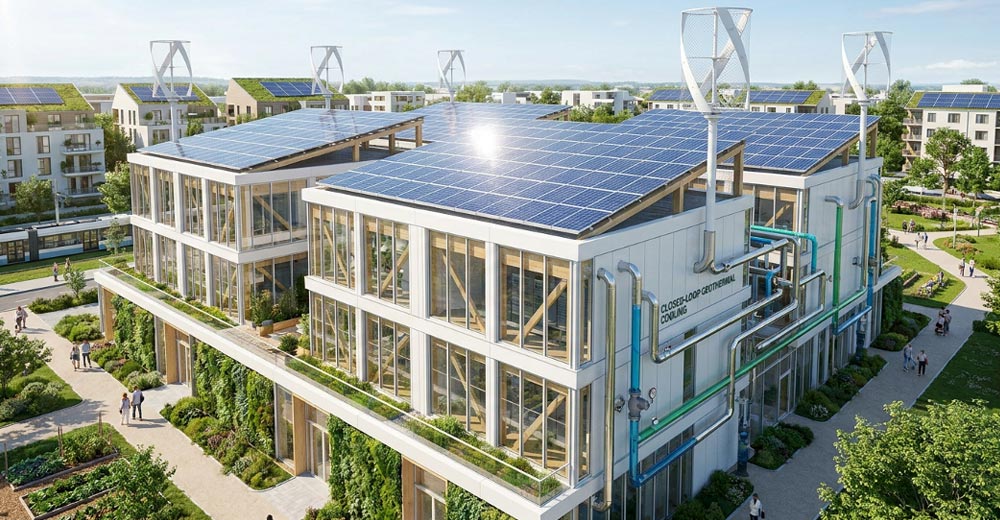
Future data centers may increasingly integrate dedicated energy sources such as solar installations, geothermal systems, or potentially small modular nuclear reactors (SMRs). The goal is to reduce pressure on municipal grids and avoid competing directly with residential power demand.
Cooling systems are also likely to evolve. Traditional evaporative cooling, while cost-effective, places heavy demands on local water supplies. Closed-loop cooling systems offer an alternative by recycling coolant internally rather than constantly drawing from external water sources.
By reducing both grid and water dependency, data centers can significantly lower their environmental footprint and reduce the likelihood of community resistance during permitting processes.
Turning infrastructure into community assets
Beyond minimizing harm, a more advanced model proposes that data centers actively contribute value to their surrounding communities.
One example is waste heat reuse. Large computing facilities generate substantial thermal energy, which can be redirected into district heating systems. In some regions, this heat is already used to warm residential buildings, schools, and public infrastructure during colder months.
Data centers can also function as grid stabilization assets. With on-site battery storage, they could provide backup power during peak demand periods or supply energy back to the grid when needed, improving overall resilience.
In addition, local access to computing resources could enable municipalities to deploy edge AI applications for traffic management, emergency response optimization, and urban planning systems.
In this model, the data center shifts from being a passive consumer of resources to an active participant in civic infrastructure.
A more sustainable growth model
If implemented effectively, these changes could reshape how communities perceive and interact with large-scale AI infrastructure.
Municipalities would benefit from tax revenue generated by high-value technology investments without absorbing the full burden of infrastructure expansion. At the same time, integrated energy and cooling systems would reduce strain on local utilities.
Secondary economic effects could include the attraction of additional technology businesses and the development of regional innovation hubs, creating high-skill employment opportunities.
Environmentally, closed-loop systems and energy self-sufficiency would reduce resource conflicts, making large-scale AI deployments more politically and socially sustainable.
Wrapping up
The rapid expansion of artificial intelligence depends not just on software breakthroughs, but on physical infrastructure capable of supporting unprecedented computational demand. The current model—large, rigid, resource-intensive data centers—is increasingly misaligned with both technological and social realities.
Communities are responding to the strain on water and power systems, while hardware cycles are evolving faster than traditional construction timelines can accommodate.
Modular design, energy independence, closed-loop cooling, and community-integrated services represent a shift toward a more adaptive infrastructure model. Whether the industry adopts these changes will determine how smoothly AI expansion continues over the next decade.
The central challenge is no longer just building more data centers—it is building ones that can evolve quickly enough, operate sustainably enough, and integrate deeply enough with the communities that host them.